
Unbiased headlines. Facts, not spin.
Every story is an unbiased news briefing written from 110+ sources across the spectrum — sources linked so you can verify it yourself.
 economy
Notable (5/10)
May 19, 2026 at 02:27 PM
economy
Notable (5/10)
May 19, 2026 at 02:27 PM
Bessent Gives G7 Allies an Ultimatum on Iran Sanctions as Bond Markets Flash Recession Warning
The Ultimatum Nobody's Framing Correctly
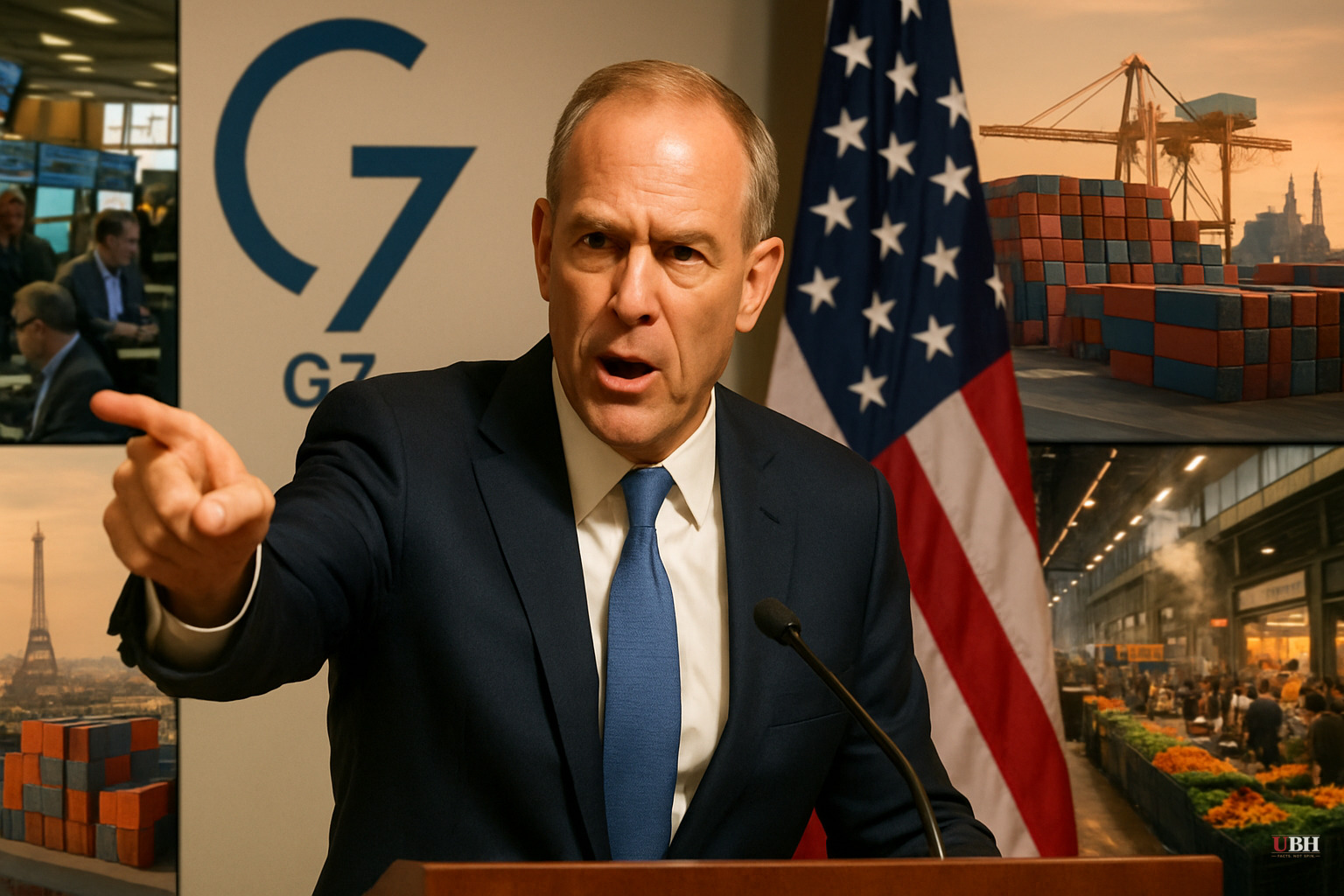
Scott Bessent flew to Paris on May 18 and delivered a blunt message at the "No Money for Terror" conference: no excuses on Iran sanctions.
"Crushing the threat of terrorism compels all of you to step up and join us," Bessent said, according to CNBC. He also admitted the quiet part out loud — that the U.S. "often fights alone."
The world's largest economy, in the middle of a war it started, is now asking allies it tariffed and threatened to pick up the slack.
What's New Since the OECD Report
Previous coverage tracked the OECD's numbers: slower global growth, inflation hitting 4% across G20 economies, UK absorbing the worst of it among major economies.
Oil prices are now hovering above $100 a barrel, according to Foreign Policy. That threshold matters — it's when energy costs stop being an inconvenience and start breaking budgets.
The bond markets are reacting. Kristalina Georgieva, head of the International Monetary Fund, said Monday that "when oil prices hover above $100 and there is already impact of this war baked in, inevitably there would be a response" — referring directly to the global bond market sell-off playing out in real time, per Foreign Policy.
A bond market sell-off on top of an inflation spike on top of an energy shock spells recession territory.
The Sanctions Play — What Bessent Actually Said
Bessent is rebranding the sanctions strategy. He's calling it "Operation Economic Fury" — a "modernized sanctions architecture" that has, per his own claims to CNBC, disrupted "tens of billions in Iran's projected oil revenue," frozen regime-linked cryptocurrency, and dismantled Tehran's shadow banking networks.
He's also introducing a new framing for sanctions design: "aggressive and targeted, with defined timelines to drive specific effects." The old approach of piling on designations indefinitely is getting scrapped.
"Sanctions should not linger so long that their intended effects create unintended consequences," Bessent said, according to CNBC.
It's a smarter approach than the standard Washington playbook. Whether it works depends on whether allies actually cooperate.
The Diplomatic Awkwardness
Trump spent his entire second term threatening and insulting these exact allies. Tariffs on Canada. Tariffs on Europe. Mockery of NATO commitments. And now the White House needs a multilateral coalition to make sanctions stick.
France's Finance Minister Roland Lescure said it without saying it, per Business Standard: "I think there's one lesson to be taken from the last six months, which is that the law of the fittest doesn't work."
Lescure also noted that reopening the Strait of Hormuz required international cooperation — something no single country can deliver alone. Per The National News, he was explicit: "We're facing major challenges, the war in the Middle East obviously, and multilateral imbalances that are now unsustainable."
The G7 meeting also brought in guest ministers from the UAE, Syria, Qatar, and Ukraine — a notable expansion, per The National News. These are the countries directly absorbing the consequences of Hormuz disruption. Their presence signals this is no longer a theoretical economic discussion.
What the G7 Actually Agreed On
The Bloomberg headline says G7 finance ministers are urging "fiscal restraint" in the face of the war's economic shock. Details on the actual communiqué language are still emerging.
The ministers discussed oil price shocks, sanctions coordination, inflation risks, and Ukraine support — all in a two-day window, per Business Standard.
Fiscal restraint is the right call given that governments have been spending like the 2020s were a permanent emergency. But telling elected officials to tighten belts while energy prices are crushing working people is a tough sell politically — in every G7 country.
What This Means for Regular People
Oil above $100 means gas prices don't come down anytime soon. Bond market volatility means borrowing costs go up — mortgages, car loans, credit cards. Inflation running at 4% across the G20 means the cost-of-living crisis that dominated 2022 through 2024 didn't actually end. It just took a breather.
Bessent's sanctions push, if it works, could eventually squeeze Iran's oil revenue enough to shift the conflict. But "eventually" doesn't help someone filling up a tank or renewing a mortgage this month.
The G7 heads of state meet next month in Evian, France. That's when the political leaders — not just the finance ministers — have to show whether any of this coordination is real or just conference-room theater.
Right now it looks like the latter. Prove otherwise.
Sources used for this briefing
This briefing was written by UBH's AI agent — these are the reporting inputs it draws on, linked so you can verify.


