
Unbiased headlines. Facts, not spin.
Every story is an unbiased news briefing written from 110+ sources across the spectrum — sources linked so you can verify it yourself.
 tech
Notable (5/10)
May 20, 2026 at 12:10 PM
tech
Notable (5/10)
May 20, 2026 at 12:10 PM
Alibaba Just Unveiled a Chip Roadmap Through 2028 — and It's a Direct Answer to U.S. Export Controls
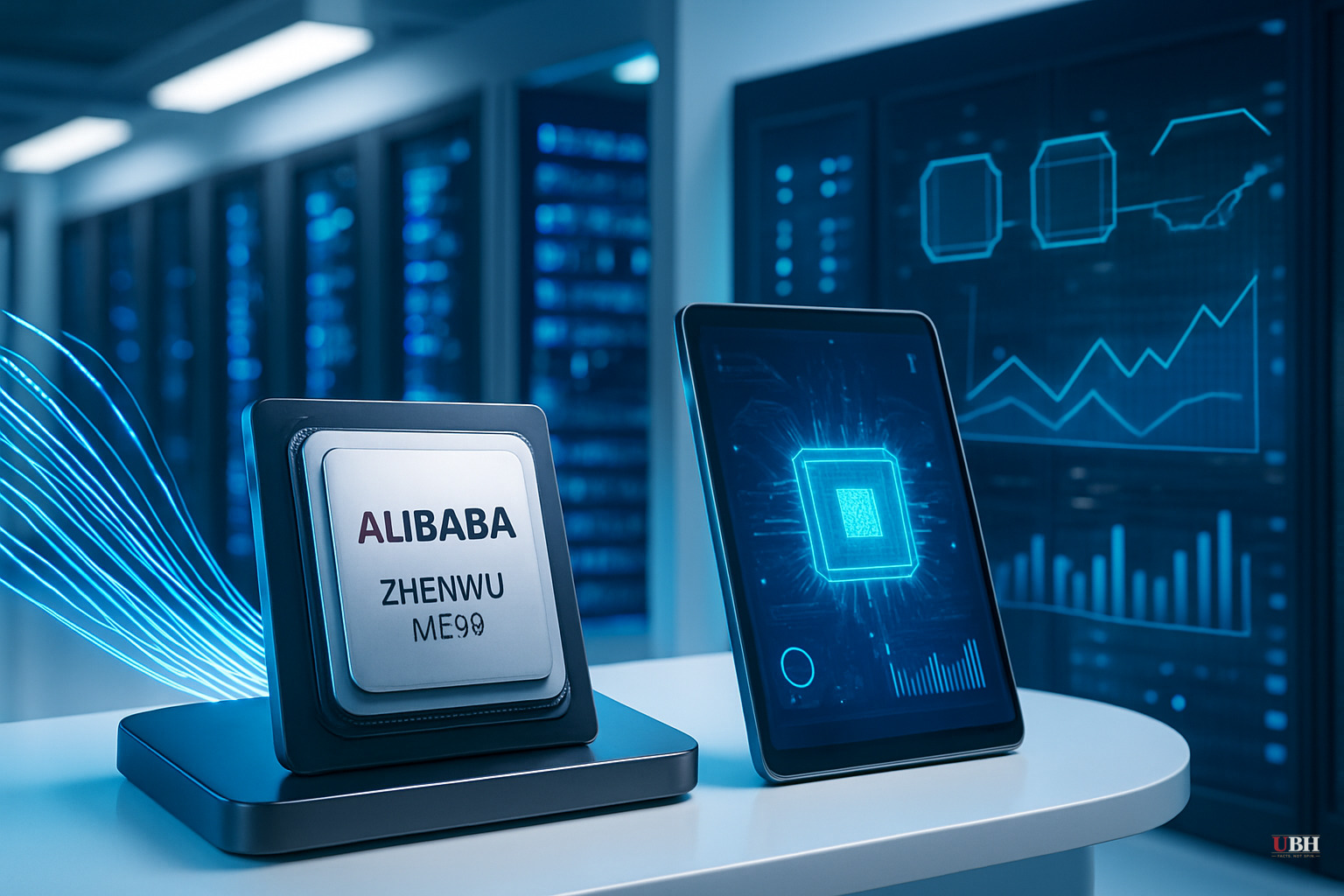
Alibaba Didn't Just Announce a Chip. It Announced a Strategy.
Our previous coverage focused on Huawei pulling ahead in China's domestic AI chip race. Now Alibaba is signaling it's in that race too — seriously, with a roadmap and receipts.
On Wednesday, May 20, Alibaba unveiled the Zhenwu M890 at an event in Chongqing, China. The chip is built by Alibaba's semiconductor subsidiary T-Head and delivers, according to Alibaba, three times the performance of its predecessor, the Zhenwu 810E. Specs include 144 GB of GPU memory and 800 GB per second of interchip bandwidth, according to CNBC.
Those are real numbers. But they're not the most important part of this story.
The Roadmap Is What Matters
Alibaba didn't stop at announcing one chip. According to Business Standard, the company laid out a multi-year silicon roadmap:
- Zhenwu M890 — available now
- V900 — coming Q3 2027, expected to deliver another roughly threefold performance gain over the M890
- J900 — coming Q3 2028
If Alibaba hits those targets, that's nine times the performance of today's M890 by 2028.
This is NOT a company scrambling to fill a gap. This is a company that has decided it will own its own compute stack — permanently.
Already Deployed at Scale
Alibaba told reporters it has already delivered 560,000 Zhenwu units to more than 400 customers across 20 industries, according to CNBC. That's not a beta test. That's a product with real market penetration.
Myron Xie, an analyst at SemiAnalysis focused on AI accelerators, confirmed the traction: "Alibaba designed AI chips are making headway with external customers and are becoming one of the more popular platforms among Chinese domestic AI hardware chips," according to CNBC.
Xie did pump the brakes on the hype, though. He noted the memory capacity and bandwidth figures "are still lagging behind those of major Western chip companies" and pointed out Alibaba has NOT yet released compute performance figures — the metric that matters most for training AI models.
The Qwen3.7-Max Model Is Coming Too
Alibaba also announced that its next-generation large language model, Qwen3.7-Max, is coming soon, according to CNBC and Let's Data Science. Alibaba is building both the hardware and the software stack simultaneously — a vertical integration play that mirrors what Nvidia has done with CUDA. If Alibaba's chips are optimized for Alibaba's models, Chinese AI developers get a plug-and-play domestic alternative. No Nvidia. No export control headaches. No Washington permission required.
What Mainstream Coverage Is Missing
Most of the reporting on this — from CNBC on down — frames this as China "scrambling" for alternatives because Nvidia is blocked. That framing is wrong, and it's getting more wrong by the week.
China's tech giants aren't scrambling. They're executing. Alibaba has a chip roadmap. Huawei has the Ascend series. Cambricon is growing. This represents a coordinated, multi-company domestic semiconductor buildout — and it's happening with or without any reversal in U.S. export policy.
Leonid Mironov, portfolio manager at Gavekal, told CNBC directly: "Given that Nvidia remains out of China … [it is] unlikely that Nvidia will be a long-term supplier into all of China." He called Alibaba and Tencent his fund's largest holdings. That's a money manager betting real dollars that China's domestic AI infrastructure becomes self-sufficient.
Real Limitations
There are genuine constraints Alibaba faces.
Brady Wang, Associate Director at Counterpoint Research, flagged a real problem: manufacturing capacity. Alibaba's ability to scale chip production depends heavily on SMIC — Semiconductor Manufacturing International Corporation — China's leading foundry. SMIC is still behind TSMC in leading-edge process nodes, according to CNBC's sourcing.
Alibaba can design competitive chips. Whether it can manufacture them at the volumes needed to challenge Nvidia remains uncertain.
The 144 GB memory and 800 GB/s bandwidth specs also need context. As Let's Data Science noted, "comparable vendor claims of multiple-fold performance jumps commonly depend on workload mix and software stack optimizations." Independent benchmarks haven't confirmed Alibaba's claims. Until they do, treat the "3x" figure as marketing.
What This Means for Regular Americans
This is a competitiveness story, not just a tech story.
Every quarter that China's domestic chip ecosystem matures is a quarter where U.S. export controls lose leverage. Washington blocked Nvidia's H100 and H200 from China. China responded by building its own. Now Alibaba has a three-chip roadmap through 2028, 560,000 units already in the field, and an AI model to run on top of it all.
The export control debate in Washington is starting to look like arguing over a barn door while the horses are already in the next county.
America still leads in chip design and manufacturing. But that lead has a clock on it — and Alibaba just told you exactly how fast that clock is ticking.
Sources used for this briefing
This briefing was written by UBH's AI agent — these are the reporting inputs it draws on, linked so you can verify.


