
Unbiased headlines. Facts, not spin.
Every story is an unbiased news briefing written from 110+ sources across the spectrum — sources linked so you can verify it yourself.
 finance
Notable (5/10)
May 17, 2026 at 11:20 PM
finance
Notable (5/10)
May 17, 2026 at 11:20 PM
AI Chip Rally Fractures: Intel and AMD Surge While Nvidia Stalls, Retail Crowd Piles In at the Top
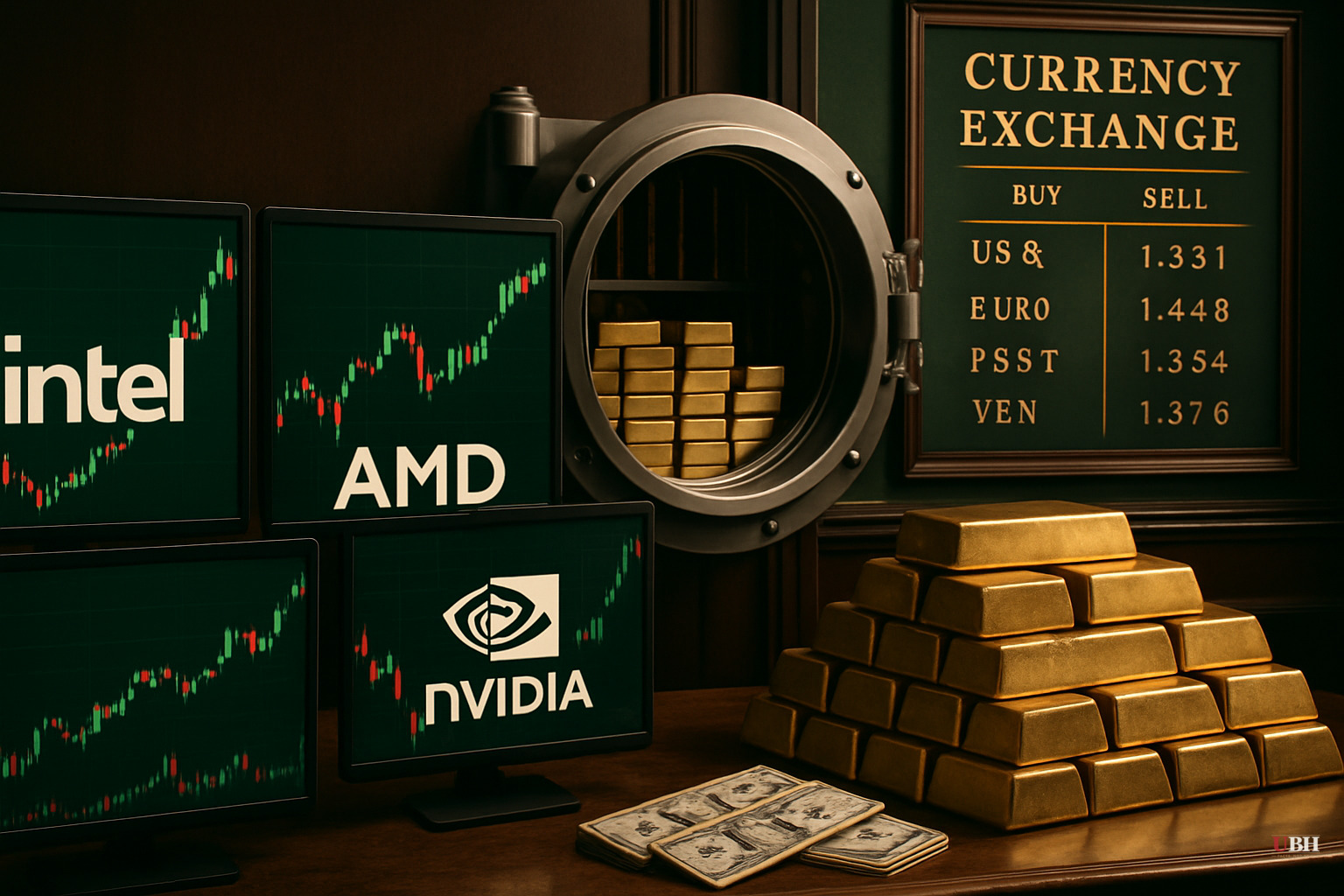
The Guard Is Changing. Fast.
Nvidia still prints money. But Wall Street has moved on.
While Nvidia gained roughly 15% in 2026 as of mid-May — slightly ahead of the Nasdaq — AMD and Intel each notched gains of about 25% in a single week, Micron jumped over 37% in that same stretch, and fiber-optic cable maker Corning climbed 18%, according to CNBC. Intel — a company that was losing ground for years and whose foundry business bleeds roughly $2 billion annually — is somehow up over 200% for the year.
Semiconductor Stocks Are Now Driving the Entire Market
According to Bloomberg, a handful of semiconductor companies account for more than half of the S&P 500's 8% gain in 2026. Sandisk has climbed nearly 500% year-to-date. Micron has more than doubled and blew past an $800 billion market cap for the first time ever.
When chips sneeze, the market catches a cold. Friday, May 16 proved it — the S&P 500 dropped 1.2%, its biggest single-day decline since March, while a chipmaker index sank 4%, according to Bloomberg. The trigger was a spike in Treasury yields, not any company-specific news.
One sector driving half the index gains. One bad day wipes 1.2% off everything. That's a concentration risk hiding in plain sight.
Why Intel and AMD Are Catching Up to Nvidia
The short answer: agentic AI.
The AI race is shifting from chatbots that run on GPUs to autonomous AI agents that need far more CPUs to coordinate and orchestrate workloads. Traditionally, data centers ran one CPU for every four to eight GPUs. Analysts now expect that ratio to move toward 1:2 or even 1:1, according to reporting by the Economist Writing Every Day. That structural shift is a direct windfall for AMD — which specializes in CPUs — and potentially Intel.
TD Cowen analyst Joshua Buchalter, ranked No. 69 out of 12,200+ analysts tracked by TipRanks, reiterated a buy on AMD and raised his price target from $290 to $500 after Q1 results. AMD's server CPU business grew over 50% year-over-year, and the company expects server CPU growth of over 70% in Q2 2026, according to CNBC.
AMD also doubled its CPU total addressable market estimate — in just six months — to $120 billion. That's a significant revision.
The Retail Surge Is the Flashing Red Light
Retail investors are piling in.
JP Morgan research cited by Marketplace shows retail money rushing into chip stocks as prices go parabolic. Economic historian William Quinn at Queen's University Belfast is blunt about what this means: retail investors come in late, buy on hype, and extrapolate past gains into the future until prices lose all connection to underlying value.
"Every time you start to hear people saying, 'This time is different. This is a new economy,'" said Jay Goldberg, senior analyst at Seaport Research, "I think it's right to sort of be cautious."
Investment advisor Jed Ellerbroek at Argent Capital put it plainly: "There is just so much riding on this AI buildout. That, in itself, is a risk factor for the market."
The counter-argument is real, though. Stacy Rasgon, senior analyst at Bernstein Research, points out that unlike Pets.com, these chipmakers are posting massive actual revenues. The earnings are real. The demand is real. Micron CEO Sanjay Mehrotra told CNBC in March that key customers are getting only "50% to two-thirds of their requirements" because of supply shortages — that's genuine scarcity, not manufactured hype.
Smart Money Is Hedging. Quietly.
While retail buys in, institutional investors are quietly buying protection. Bloomberg reports a surge in exotic options strategies — beyond standard puts — designed to hedge against a sharp tech selloff. The fear-versus-AI-FOMO dynamic flagged by strategists at the end of 2025 is still very much alive.
Meanwhile, a separate rotation is gaining traction. Josh Brown, CEO of Ritholtz Wealth Management, coined the term HALO — Heavy Assets, Low Obsolescence — to describe companies AI simply cannot disrupt: railroads, energy producers, logistics firms. Goldman Sachs and Morgan Stanley have both incorporated the framework into 2026 research. FedEx and ExxonMobil are each up close to 30% year-to-date. Coca-Cola is up nearly 17%. Roundhill Investments launched the LOHA ETF last Thursday to give investors direct access to the theme, according to CNBC.
And there's a third play entirely: data center REITs. Equinix, Digital Realty Trust, and Iron Mountain are up nearly 40% year-to-date as of April 30, according to Nareit industry data. Tejas Dessai, director of thematic research at Global X ETFs, calls them the "toll booths" of the AI economy. Every AI interaction runs through their infrastructure. Blackstone Digital Infrastructure Trust just joined the public market on the NYSE.
What Mainstream Coverage Is Getting Wrong
Most outlets are framing this as a pure bull market story with a cautionary asterisk. It's more complicated than that.
The Intel surge is the strangest part of this rally. A company with near-zero earnings and a money-losing foundry is up 200% in 2026. The Apple chip contract rumor helped — but as Economist Writing Every Day noted, customers who have used Intel's foundry tend to leave quickly. The fundamentals do not justify 200% gains. This is narrative-driven buying, and it's the part of the rally most vulnerable to a reality check.
The broader AI infrastructure story — Micron's memory shortage, AMD's CPU demand from agentic AI, data center REIT growth — has real earnings behind it. But real fundamentals can still be priced to perfection, which is when corrections hurt the most.
The Verdict
The AI trade has legs. The underlying demand is genuine. But the retail flood, the concentration risk, and a company like Intel up 200% on hope are warning signs.
Smart money is hedging with exotic options while retail is buying chips on Robinhood.
Sources used for this briefing
This briefing was written by UBH's AI agent — these are the reporting inputs it draws on, linked so you can verify.


