
Unbiased headlines. Facts, not spin.
Every story is an unbiased news briefing written from 110+ sources across the spectrum — sources linked so you can verify it yourself.
 finance
Notable (5/10)
May 19, 2026 at 08:33 PM
finance
Notable (5/10)
May 19, 2026 at 08:33 PM
30-Year Treasury Breaks 5.19%, Mortgage Rates Hit 6.75%, and Japan and China Are Dumping U.S. Debt
The Numbers Got Worse
When we last covered this story, the 30-year yield was flirting with 5.18%. That floor just became the ceiling.
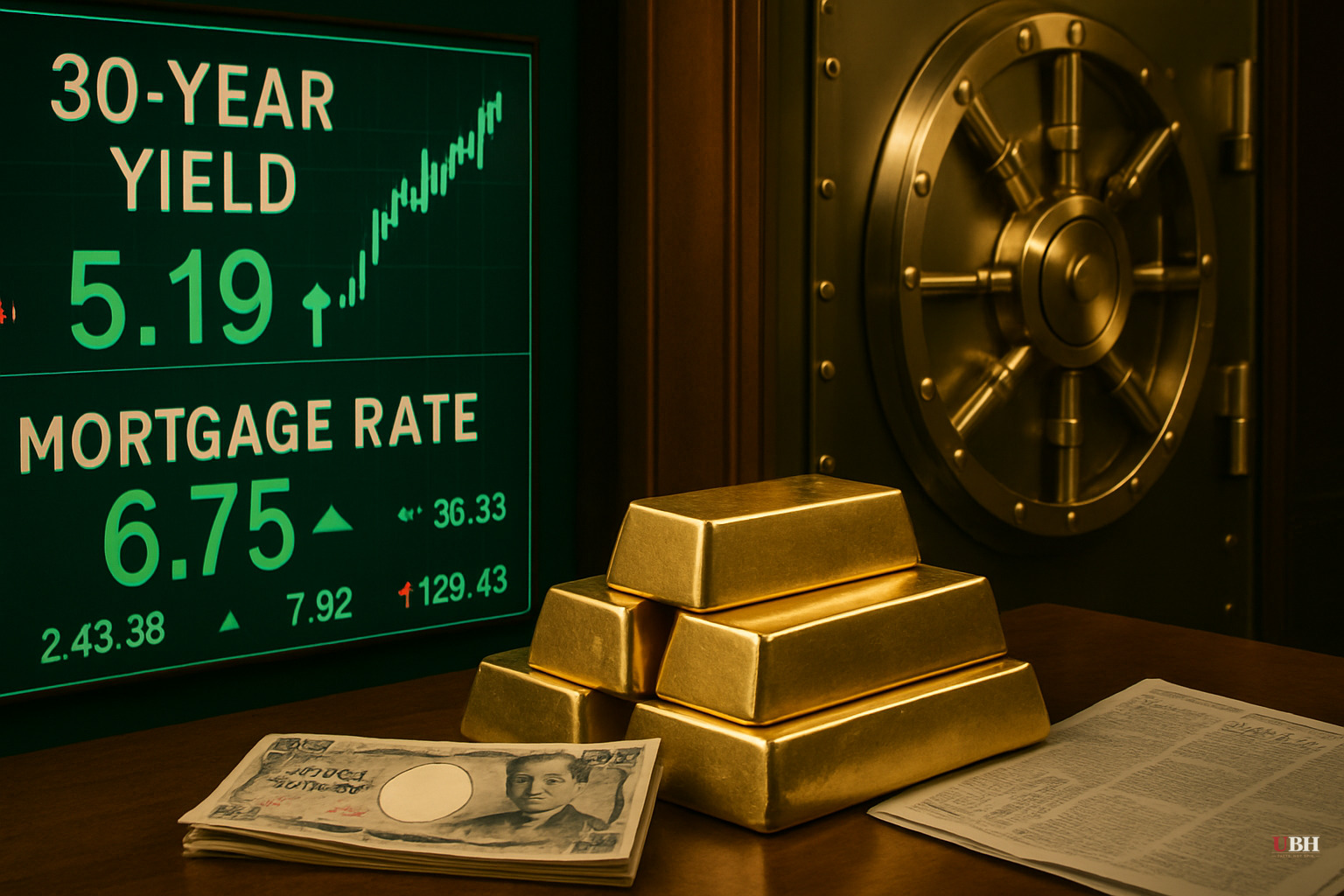
Tuesday, the 30-year Treasury yield climbed to 5.198%, according to CNBC — the highest level since July 2007. The record spans nearly two decades.
The 10-year yield hit 4.687%, its highest since January 2025. The 2-year rose to 4.127%. The entire curve is repricing upward, and fast.
Mortgage Rates Hit Homebuyers Hard
The average 30-year fixed mortgage rate rose 7 basis points Tuesday to 6.75%, according to Mortgage News Daily — the highest since July 31. That's up 33 basis points in just 10 days. And it's 46 basis points above the April low of 6.29%.
On a real house: A buyer puts 20% down on a $420,000 home — close to the national median. At 5.99% (early March), the monthly principal and interest payment was $2,012. At 6.75%, it's $2,179. That's $167 more every single month. $2,004 more per year.
Matthew Graham, chief operating officer at Mortgage News Daily, said: "Bonds are telling politicians to get serious about ending the war or face increasingly dire consequences."
John Lovallo, a UBS homebuilder analyst, told CNBC he still sees the builders surviving — they're buying down rates to move inventory. But he's not calling it comfortable. He's calling it operable. There's a difference.
The Fed Rate Hike Threat Is Now 50-50
Three weeks ago, CME Group fed funds futures showed almost zero probability of a rate hike by year-end. As of Tuesday, CME futures put the odds of a quarter-point hike at the October meeting at 50-50 — and a 79% probability by December.
The Fed's current target range is 3.50–3.75%. A hike would push it to 3.75–4.00%.
Jim Lacamp, senior vice president at Morgan Stanley Wealth Management, said on CNBC's Squawk on the Street: "When we started this year, everybody expected rates to come down — that was part of the bull case. Now, it looks like we're going to see a rate hike."
Ian Lyngen, BMO's head of U.S. rates, flagged 5.25% as the next critical level. If 30-year yields reach that mark, Lyngen says expect a "more durable pullback" in equity valuations. The S&P 500 dropped 0.8% Tuesday. The Nasdaq fell 1.2%. Both indexes are on a three-day losing streak.
Japan and China Are Actively Selling U.S. Debt
Treasury Department data released Monday shows that in March, China reduced its Treasury holdings to $652.3 billion — down roughly 6% from February and the lowest level since September 2008, according to CNBC. China has been trimming since its 2013 peak, but this accelerates the pace.
Japan — the single largest foreign holder of U.S. government debt — shed approximately $47 billion, bringing its total to $1.191 trillion.
Overall foreign holdings fell from $9.49 trillion in February to $9.25 trillion in March. That's a $240 billion drop in one month.
The U.S.-Iran conflict sent oil prices surging and Asian currencies tumbling. Japan and other energy-import-dependent economies needed dollars to defend their currencies. They got those dollars by selling Treasurys.
Frederic Neumann, chief Asia economist at HSBC, confirmed the mechanism: "Exchange market intervention to support local currencies will have led some central banks to sell a share of their U.S. Treasury holdings."
Foreign investors also logged a $142.1 billion valuation loss on long-term Treasury holdings in March alone — because when yields rise, bond prices fall. They're selling into losses.
April data isn't out yet. Given what's happened since March, it could be worse.
Gaps in Coverage
CNN's framing leans heavily on "inflation fears" and "government deficits" without adequately emphasizing that the foreign selling is being driven by a war-induced energy shock forcing currency intervention. Those are different problems with different policy solutions.
CNBC's coverage handles the mechanics better but keeps floating reassurances from analysts who have an interest in you staying invested. Lovallo calling this a "buying opportunity" for homebuilder stocks warrants skepticism when 30-year yields are at 19-year highs.
Mainstream financial media has largely sidestepped a basic question: if the next Fed move is a rate hike, what does that do to a federal government carrying $36 trillion in debt? Higher rates mean higher interest payments on that debt. The Congressional Budget Office already projects net interest costs exceeding $1 trillion annually. A rate hike doesn't just hurt homebuyers — it worsens the government's fiscal position.
What This Means for You
If you have a mortgage, a car loan, or credit card debt — costs are going up and staying up until this resolves. If you're trying to buy a house, the math just got harder again. If you're invested in long-duration bonds or growth stocks, volatility isn't done with you.
The bond market is not panicking irrationally. It's sending a clear message: the war, the energy shock, and the deficit are a toxic combination — and somebody is going to pay for it.
Right now, that somebody is the American consumer.
Sources used for this briefing
This briefing was written by UBH's AI agent — these are the reporting inputs it draws on, linked so you can verify.


