
Unbiased headlines. Facts, not spin.
Unbiased Headlines is an independently owned news organization. We bring you the facts, not opinions, written fresh from 110+ named sources. Sources linked so you can verify it yourself.
 tech
Major Story (7/10)
Pentagon-Blacklisted Chinese Lidar Maker Hesai Deepens Nvidia Partnership Despite National Security Concerns
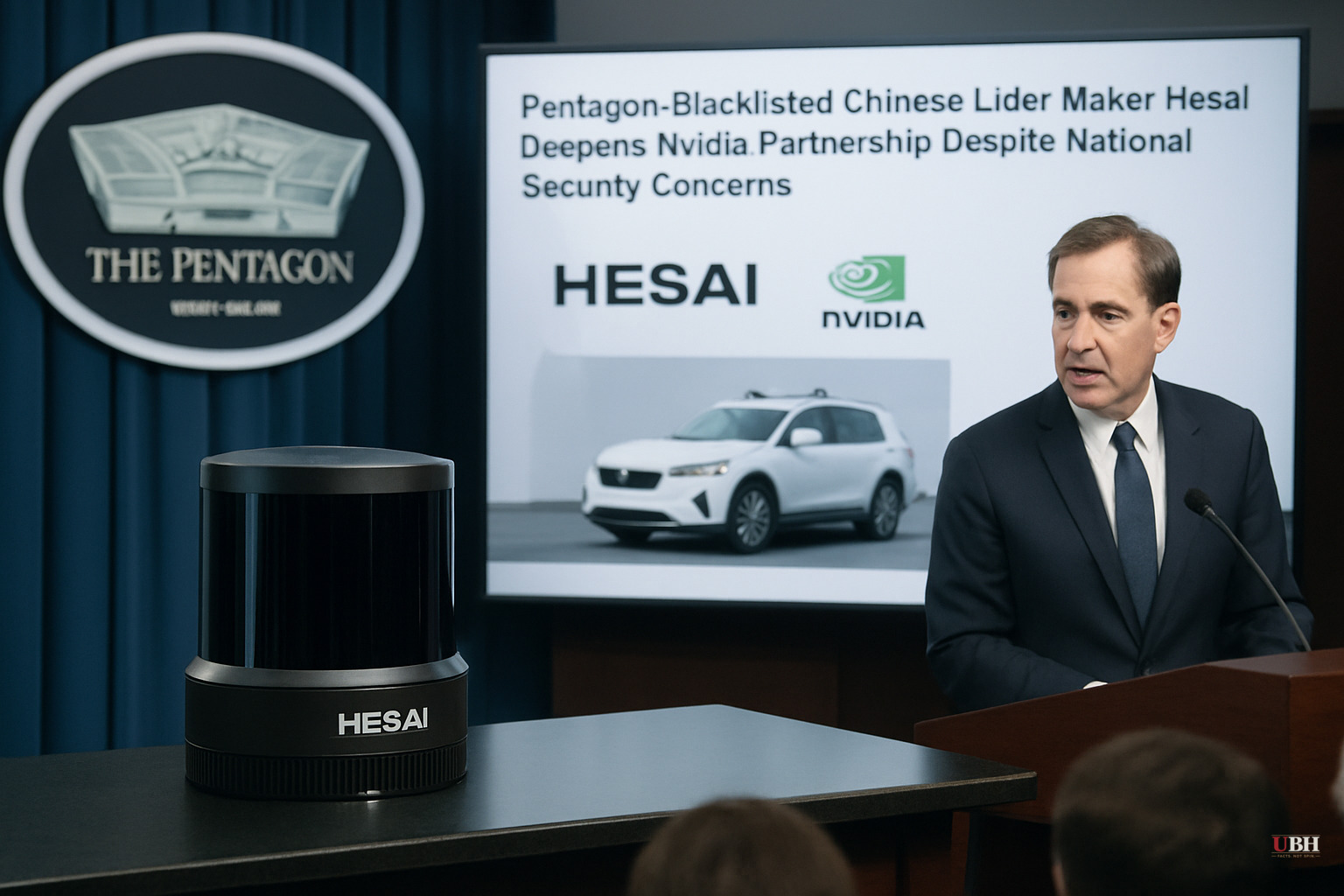
Hesai Technology makes the lidar sensors that let robots, self-driving cars, and autonomous trucks perceive the physical world. It is also on the U.S. Department of Defense's list of companies designated as Chinese military entities, a designation the DoD applied in 2024.
Being on that list blocks Hesai from winning Pentagon contracts. It does NOT make it illegal for American companies to buy or use Hesai's products in civilian applications. That distinction matters, because Hesai's sensors are currently embedded in a wide range of U.S. commercial technology platforms, according to CNBC.
Nvidia's Bet
Nvidia CEO Jensen Huang announced an expanded partnership with Hesai at the Consumer Electronics Show in January 2026. Under that deal, Hesai sensors are among the options automakers can select when building on Nvidia's autonomous vehicle platforms.
Huang has publicly described robotics and autonomous vehicles as Nvidia's second most important growth category after AI. Nvidia's own annual filing reported automotive revenue for fiscal year 2026 was up 39% year-over-year, driven by adoption of its self-driving platforms.
That growth now runs, in part, through a supplier the Pentagon has flagged as a national security concern.
Who Else Is Using Hesai
The exposure extends well beyond Nvidia. According to CNBC, Hesai sensors are integrated into systems used by Amazon's robotaxi company Zoox, autonomous trucking firms Waabi and Kodiak, autonomous vehicle technology company Nuro, and agricultural automation company Agtonomy. The sensors have also been deployed in New York.
Hesai is one of the dominant lidar vendors globally, and its presence inside U.S. autonomous infrastructure is substantial.
The Security Argument
Government officials and security experts quoted by CNBC argue that lidar sensors embedded in critical infrastructure could serve as a data collection vector for Beijing. The concern is specific: lidar doesn't just detect obstacles, it maps environments in high resolution. Sensors embedded in delivery robots, autonomous trucks, and self-driving cars are continuously building detailed spatial maps of American roads, warehouses, ports, and urban environments.
If that data can be accessed or exfiltrated by a foreign government, the argument goes, it represents a meaningful intelligence and security risk. The DoD designation reflects that concern, even if the legal mechanism only restricts federal contracts.
Hesai's Response
Hesai co-founder and CEO David Li pushes back directly. In what CNBC described as his first extended interview specifically addressing the blacklist designation, Li said: "In the DOD case, I don't feel there is sufficient evidence, and it's not logical. We are frustrated by that."
The DoD's Chinese military company list has been contested in court before by other listed firms, and the designation process is not transparent. Companies on the list are not accused of a specific crime, are not charged with anything, and face no public evidentiary standard. A company can be listed based on assessments that are never fully disclosed. That represents a due-process concern.
Hesai has also not been charged with any crime, and no public investigation finding espionage or data theft has been announced as of July 7, 2026.
The Structural Risk
Chinese national security law requires Chinese companies to cooperate with Chinese intelligence services upon request. That obligation exists regardless of whether any specific company wants to comply. The risk critics are pointing to is not that Hesai's leadership is actively spying. It's that Chinese law creates a mechanism for compelled cooperation that no corporate policy or contractual assurance can override.
That's the same logic behind the TikTok debate, the Huawei ban, and every other Chinese tech restriction the U.S. government has pursued over the past several years. Whether that logic applies with equal force to lidar hardware as to software and telecommunications is a question policymakers have not yet answered with a formal legal framework.
What the Gap in Policy Costs
The DoD blacklist exists. A broader civilian-use restriction does not. That gap means Hesai sensors can be deployed inside the logistics networks, road infrastructure, and autonomous systems that U.S. companies are building right now, with no legal barrier and no federal disclosure requirement.
Congress has moved to restrict other Chinese technology in specific sectors. Whether lidar gets the same treatment will depend on whether legislators decide the data-collection risk from autonomous sensors is comparable to the risks they've already acted on. No such legislation has been enacted as of July 7, 2026, and none has been publicly scheduled for a vote.
Sources used for this briefing
1 link from 1 independent newsroom (syndicated copies of the same report count once)
These are the sources it draws on, linked so you can verify.


